Teens and Games
Originally posted on: Grand Text Auto by Dr. Mary Flanagan Perhaps you have heard reports of the new study funded by Pew and MacArthur on...
26 September, 2008


Originally posted on: Grand Text Auto by Dr. Mary Flanagan Perhaps you have heard reports of the new study funded by Pew and MacArthur on...
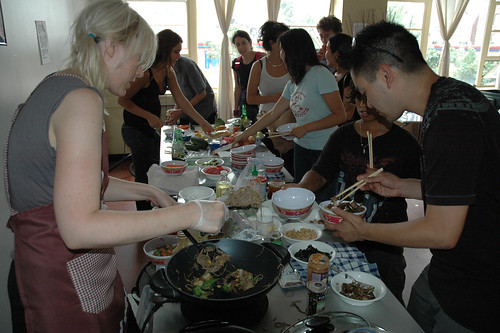
I love Massively Multiplayer Soba because it is simple and it works. In an academic paper, I might say the game explores tolerance and diversity by facilitating inter-cultural exchanges around regional cuisine. But really, Soba just gets strangers talking about food. We live in a country flayed by partisan divides, with too much time spent thinking about trivial differences. Even in New York where people from all over live side by side, it’s rare for us to take the time to interact with each other. But games give people excuses to be extroverts. And food is a universal passion. With Soba, we give strangers an excuse to discuss commonalities, and the results are just good.
That's right, since we started selling our Grow A Game cards, folks have been buying them like they were frosted home cooking. ...
This Saturday come join the Tiltfactor team at the 2008 Conflux Festival for the launch of our first urban game: Massively Multiplayer Soba....

I am by no means the first to report this, but there are some eerie similarities between Tom Clancy’s Ghost Recon game from 2001 and the current conflict in South Ossetia. Ghost Recon is set in April 2008 when an ultra-nationalist Russian president seeking to rebuild the Soviet Union invades Georgia. US Green Berets are deployed to South Ossetia to battle armed rebels and Russian troops. In reality, the conflict broke out in August, not April, and Russia was defending itself after Georgia staged a sneak attack in South Ossetia against Russian peace keepers and civilians, but the way the US media has portrayed Russia as the aggressor, you’d think Tom Clancy was dead on.
Commentators pointing out the similarity between Ghost Recon and reality have noted that the key difference is that no US troops were involved in the fighting, but in fact that’s a detail Clancy got right. We don’t know of any Green Berets in the conflict, but Russian media has reported US instructors guiding Georgian forces. Civilians in South Ossetia claimed to see soldiers in black uniforms with American flags on their sleeves. Even if the accounts of black uniformed soldiers were innacurate, there were definitely NATO training excercises and US military instructors in Georgia this past July. I wonder if any of those soldiers ever played Ghost Recon. I wonder how the experience playing the game affected their experience guiding real soldiers in such a similar conflict.
At the Games Learning and Society conference this past July many people claimed that we’re witnessing the gestation of ludic century. This will be an era of games everywhere, from the classroom to the living room to the factory floor. Perhaps this is so. We are already seeing the rise of ludic warfare.
via: Times

By Bryan Appleyard
At the World Economic Forum in Davos in January 2005, Nicholas Negroponte, supreme prophet of digital connectivity, revealed a strange tent-like object. It was designed to change the world and to cost $100. It was a solar-powered laptop. Millions would be distributed to children in the developing world, bringing them connection, education, enlightenment and freedom of information. The great, the good, the rich and the technocrats nodded in solemn approval.
And then some of them tried to kill it.
Microsoft, makers of most of the computer software in the world, tried to kill it with words, and Intel, maker of most computer chips, tried to kill it with dirty tricks. Of course, they don’t admit to being attempted murderers. And when I introduce you to Intel’s lovely spokesperson, Agnes Kwan, you’ll realise how far their denials go. But the truth is the two mightiest high-tech companies in the world looked on Negroponte’s philanthropic scheme and decided it had to die.
Yet, 3½ years later, the laptop is clinging on to life. It costs around $190 rather than $100 and it is called the XO. It is no longer like a tent, but it can still be solar-powered. It is a technological triumph. But only 370,000 are in use and another 250,000 ordered. One Laptop Per Child (OLPC), the company formed to run the project, is still driven by the same old idealism, geekery and technical brilliance. But Negroponte and his young staff are older and wiser. They were stunned by the savagery of the competition they faced – competition plainly intended to destroy a philanthropic idea. “I had wildly underestimated,” says Negroponte, “the degree to which commercial entities will go to disrupt a humanitarian project.”
For three reasons the XO turned out to be a gross provocation to the big players in the computer industry. First, it was always going to be cheap, undercutting the competition by thousands. Computers only cost as much as they do because the makers of the software – primarily Microsoft – go to enormous lengths to make their products necessary and expensive, and because makers of the hardware are constantly adding new features that you probably don’t need.
In fact, electronics have plummeted in price and there’s no real reason why you can’t get a decent laptop for a maximum of $400.
Second, the XO uses an AMD chip. The monopoly chip-maker in the world is Intel. It has three-quarters of the market, with AMD second. AMD and Intel hate each other with a hatred as hard as that of Hamas and the Israelis. For Intel, the idea of hundreds of millions of AMD laptops out there was intolerable. Intel could lose their market leadership – but not if Agnes has anything to do with it.
Third, it does not use software by Apple or Microsoft. Instead, it is run by Sugar, a free operating system devised by geeks for the love of it. For Microsoft in particular this was also intolerable. Its Windows operating system is the industry standard. Apple’s system is much better, but Windows, through sheer Microsoft muscle, has been made to appear necessary. The new massive non-Windows user base threatened by the XO is the sort of thing that seriously cuts into Bill Gates’s me time.
“This was a project that could operate outside the regular business world,” says Ethan Beard, a former OLPC board member representing Google, one of its backers, “and that’s not an unreasonable expectation. But it is in some ways threatening to businesses and when you threaten businesses, especially very large ones, they are going to react in ways that hurt you.”